


Key Characters:
Growth Form: Sprawling perennial herbs, regenerating from underground tubers (potatoes).
Stems: Stems green, somewhat succulent, young parts sparsely pubescent with simple (rarely glandular, never stellate) hairs, unarmed, during growth underground stolons develop tubers at apex.
Roots:
Leaves: Leaves compound (pinnate). Alternate. Blades with 5–9 leaflets, ovate–elliptic in outline overall, leaflets ovate, lower ones rounded or acute, upper ones acuminate, much smaller interstitial leaflets along the leaf rachis, petioles and leaf rachis angular in section, sometimes narrowly winged. Apex acute to acuminate or shortly acuminate. Base generally oblique, rounded to cuneate to cordate. Surfaces nearly glabrous to densely pubescent. Leaflet margins entire to undulate. Petioles 2.5-5 cm long. Stipules absent.
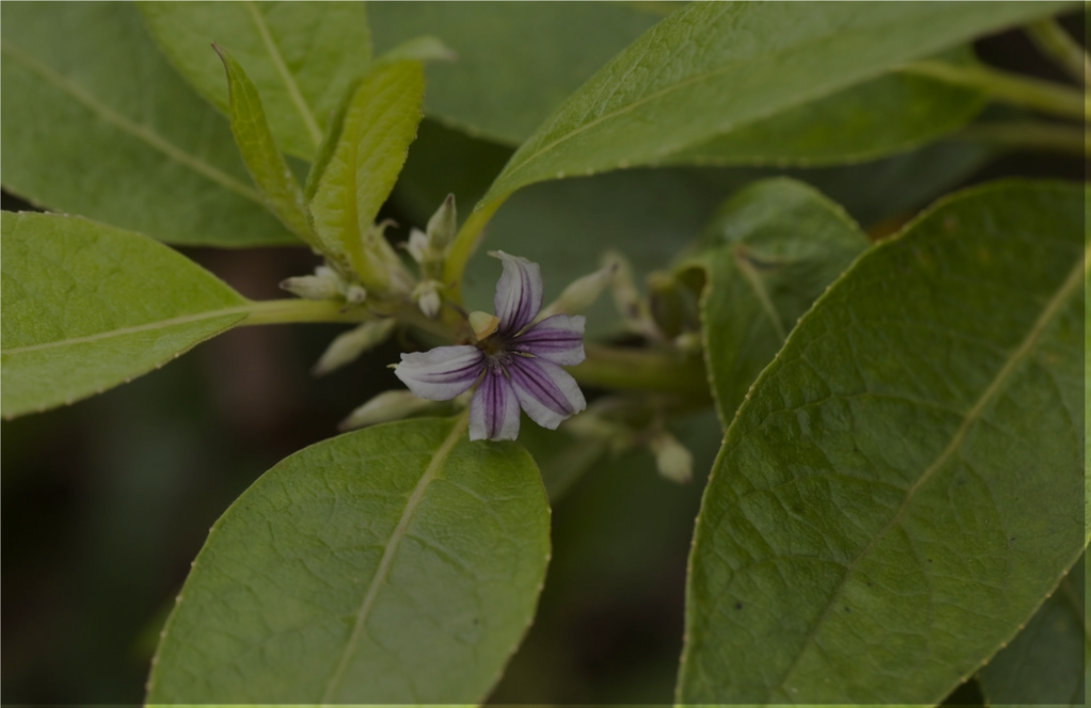
Flowers: Flowers few to 10 in leaf-opposed, cymose panicles; peduncles 5–10 cm long. Flowers bisexual (perfect), actinomorphic; pedicels 1–2 cm long with an articulation shortly below the calyx. Calyx tube ca. 5 mm long, the lobes lanceolate, 5–8 mm long, apex acuminate. Corolla white or pale violet, subrotate to rotate–pentagonal. Stamens inserted on corolla tube; filaments short and thick, ca. 2 mm long; anthers yellow, oblong, cordate below, 5–7 mm long, opening by terminal slits. Ovary superior, subglobose; style 1, erect; stigma green, terminal.
Fruit: Berries green; succulent; globose; 1.5–2 cm in diameter; often sparsely produced. Seeds numerous; pale reddish brown; obovate to ovate; lenticular; with a small wing at base; ca. 2 mm long; smooth or finely reticulate.
Ploidy: 2n = 24; 36; 48; 72; 96
Habitat: Cool temperature regions and higher altitudes in the tropics.
Elevation Range:
ca. 2,740 m.
Naturalized


Name Published In: Sp. Pl.: 185 (1753)
Other References
Wagner et al. 1990:1276 (EM [reportedly nat. inside Haleakalā Crater, 1927]); Staples & Herbst 2005:536 (KEY), 539 (DESCR); Forest Starr pers. comm. 2025 (Note: populations persist at Polipoli and within Haleakalā crater)
| SNo. | Scientific Name | Locality | Habitat | Basis of Record | Description | Recorded By | Record Number | Island | Source | Date |
|---|---|---|---|---|---|---|---|---|---|---|
| 1 | Solanum tuberosum | Slopes of Haleakala | Preserved_Specimen | Forbes, C.N. | 1103 | Maui | BISH | 1919-08-10 | ||
| 2 | Solanum tuberosum | Kalaheo, M.Emrick, Honua Farm, Kikala Rd | Preserved_Specimen | Stem with some purple wash. Leaves above bright green, dull, below paler. Inflorescence: pedicels of some flowers purplish; petals white with yellow central stripe; anthers bright yellow, filaments yellow-green; stigma green, style whitish | Hume, L. | 393 | Kauai | BISH | 1989-07-27 | |
| 3 | Solanum tuberosum | East Maui, Makawao District, Gulch on Kaupakalua road just before the juction with W Kuiaha road, Haiku | Cultivated waste area | UNKNOWN | . Coordinates do not match to country in source data. Not found a country in reverser geocoding. Bioversity International | R. E. Palmer | Maui | HAPI | 3/4/1998 | |
| 4 | Solanum tuberosum | East Maui, Haleakala Crater, Kaupo Gap | Preserved_Specimen | Forbes, C.N. | Maui | BISH | ||||
| 5 | Solanum tuberosum | George Peabody residence, east end, mile 19 | home garden, open valley floor, sunny seacoast | Preserved_Specimen | small, upright, open, 1' tall; stem green to tan, gnarled. Lvs dull green, simple, venation prominent on underside. Produces pea-sized, purple-blue potatoes. | Evans, M. | 11 | Molokai | BISH | 1990-06-30 |
Lorem ipsum dolor sit amet, consectetur adipiscing elit, sed do eiusmod tempor incididunt ut labore et dolore magna aliqua. Ut enim ad minim veniam, quis nostrud exercitation ullamco laboris nisi ut aliquip ex ea commodo consequat. Duis aute irure dolor in reprehenderit in voluptate velit esse cillum dolore eu fugiat nulla pariatur. Excepteur sint occaecat cupidatat non proident, sunt in culpa qui officia deserunt mollit anim id est laborum.
Lorem ipsum dolor sit amet, consectetur adipiscing elit, sed do eiusmod tempor incididunt ut labore et dolore magna aliqua. Ut enim ad minim veniam, quis nostrud exercitation ullamco laboris nisi ut aliquip ex ea commodo consequat. Duis aute irure dolor in reprehenderit in voluptate velit esse cillum dolore eu fugiat nulla pariatur. Excepteur sint occaecat cupidatat non proident, sunt in culpa qui officia deserunt mollit anim id est laborum.
Lorem ipsum dolor sit amet, consectetur adipiscing elit, sed do eiusmod tempor incididunt ut labore et dolore magna aliqua. Ut enim ad minim veniam, quis nostrud exercitation ullamco laboris nisi ut aliquip ex ea commodo consequat. Duis aute irure dolor in reprehenderit in voluptate velit esse cillum dolore eu fugiat nulla pariatur. Excepteur sint occaecat cupidatat non proident, sunt in culpa qui officia deserunt mollit anim id est laborum.
Lorem ipsum dolor sit amet, consectetur adipiscing elit, sed do eiusmod tempor incididunt ut labore et dolore magna aliqua. Ut enim ad minim veniam, quis nostrud exercitation ullamco laboris nisi ut aliquip ex ea commodo consequat. Duis aute irure dolor in reprehenderit in voluptate velit esse cillum dolore eu fugiat nulla pariatur. Excepteur sint occaecat cupidatat non proident, sunt in culpa qui officia deserunt mollit anim id est laborum.
Lorem ipsum dolor sit amet, consectetur adipiscing elit, sed do eiusmod tempor incididunt ut labore et dolore magna aliqua. Ut enim ad minim veniam, quis nostrud exercitation ullamco laboris nisi ut aliquip ex ea commodo consequat. Duis aute irure dolor in reprehenderit in voluptate velit esse cillum dolore eu fugiat nulla pariatur. Excepteur sint occaecat cupidatat non proident, sunt in culpa qui officia deserunt mollit anim id est laborum.
Lorem ipsum dolor sit amet, consectetur adipiscing elit, sed do eiusmod tempor incididunt ut labore et dolore magna aliqua. Ut enim ad minim veniam, quis nostrud exercitation ullamco laboris nisi ut aliquip ex ea commodo consequat. Duis aute irure dolor in reprehenderit in voluptate velit esse cillum dolore eu fugiat nulla pariatur. Excepteur sint occaecat cupidatat non proident, sunt in culpa qui officia deserunt mollit anim id est laborum.
Thank you for your interest in submitting an image of
Select your image and leave a brief description of your photo below.